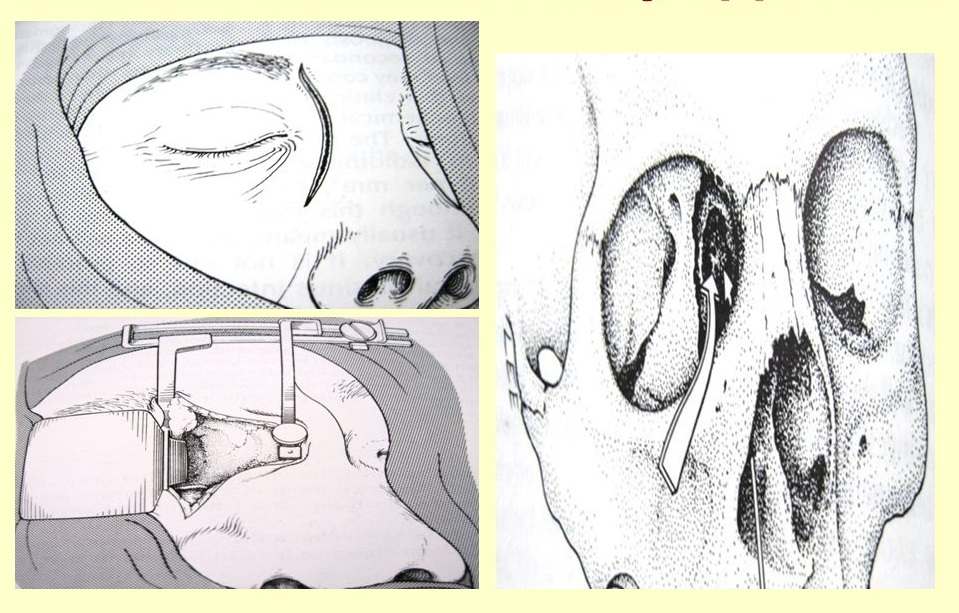
Nasal valve is the narrowest part of the nose but c greatest resistor to produce the most turbulent airflow. It is formed by:
- The lower edge of the upper lateral cartilages
- The anterior end of the inferior turbinate.
- The adjacent nasal septum together c the surrounding soft tissues.
The following are two objective ways to measure nasal obstruction:
Rhinomanometry:
Two measurement are used to calculate Nasal resistance to air flow. These are:
- Nasal airflow
- Transnasal pressure
These two parameter are measure by using manometers (differential pressure transducer). This is why the study of nasal resistance to air flow is termed “Rhinomanometry” .
Nasal air flow is
- measured by flow head consisting of gauze resistance inside a cone shape tube.
- Pressure difference across the gauze generated by airflow through tube.
Transnasal pressure:
- Measured by relating the pressure at posterior nares to that at the entrance of the nostril (atmospheric pressure/ nasal mask pressure)
Active Rhinomanometry
- Generation of nasal airflow and pressure c normal breathing.
- Based on the location of the pressure serving tube
1. Anterior rhinomanometry
- Tube taped to one nasal passage and sealed nasal passage act as an extension of the pressure seming tube to measure pressure in posterior nares.
- Nasal airflow measured from 1 nostril at a time. Total resistance =sum of bilateral (surgical tape used to seal)
- Most commonly used
2. Posterior Method
- Tube held in mouth.
- Detect post nares pressure when soft palate allow an airway to the mouth.
- Simultaneous measured of both nasal passage or separately by tapping off one.
- Disadvantages: Not all patient can obtain an airway around soft palate into mouth.
Passive Rhinomanometry
- Generation of nasal airflow pressure from an external source (fan/pump) to drive air into the nose direction of an external flow of air through nose out of the mouth.
- Measures either:
- driving pressure at the constant flow
- Measurement of flow at constant pressure
- Separate upper and lower airways.
Nasal airway resistance can also be measured by heat out body plethysmography (displacement types).
- Flow head (side of body box )
- Pressure serving tube passed along the floor of nasal cavity.
R=ΔP/V
R= resistance to airflow in cm H2O/Lit/sec(Pa/cm³)
ΔP=transnasal pressure in cm H2O or Pa
V= nasal airflow in liters/cm³ (does not consider separate components of laminar and turbulent airflow)
x/y plotter shows curvilinear relation for ΔP/V plot
Nasal airflow∝ trans nasal pressure. but higher the pressure ∼limited the airflow due to friction/turbulent airflow.
- Universal standard: Unilateral nasal airflow measured at sample pressure point of 150 Pa.
B/L nasal airflow measured at 75 Pa(For Asian 100 and 50 Pa)
Adult: N total resistance= 0.15 -0.39 Pa cm³s³
Infant>Adult
Male>Female
2. Acoustic Rhinometry: Acoustic pulse are generated from a spark source/speaker and the sound pulse is transmitted along a tube into the nose.